Overview
The Support Division provides the resources and systems necessary for front-line operations. The Support Division includes both sworn and civilian support staff.


Detective Sergeant
Joe Clausen
- Crime Analysts
- Detectives

Linn Interagency Narcotics Enforcement (LINE) Task Force Lieutenant
Juston Alexander
Communications
Communications is the first line of communication between citizens and patrol officers. Communications Specialists receive emergency and non-emergency calls for service, along with other requests for police assistance. Communications Specialists gather and relay crucial information to assist officers in the field with their response and investigation.

Frequently Asked Questions:
When should I call 9-1-1?
Call 9-1-1 in cases of emergency. An emergency is a serious, unexpected, often life-threatening situation that requires immediate action.
Examples:
- Domestic Violence
- Physical Fight
- Injury Car Crash
- Theft in Progress
- Suspected DUII driver
- Fire/Medical problem
- Any crime that is currently happening
If ever in doubt and in need of immediate assistance, call 9-1-1.
When to call the nonemergency line (541-917-7680)
- Crimes that are not in progress (happened last night, happened last week)
- Civil issues
- To contact an officer about a previous call for service
Other Resources
- Linn County Sheriff’s Office
541-967-3950
http://www.linnsheriff.org - Benton County Sheriff’s Office
541-847-5100
https://sheriff.bentoncountyor.gov
What information should I have ready when calling APD for assistance?
Citizens calling APD for assistance should expect to provide different information depending on the issue they are experiencing; however, some general information will be consistent across all types of requests. Citizens should expect to provide:
- Address or location of the crime
- Name
- Phone number
- Home address
- If not occurring now, the date and time the crime occurred
- Suspect information (i.e., name, physical description, clothing description, direction of travel)
- If crime was a theft, property that was taken, along with serial numbers if available
- If the crime was a theft of a motor vehicle or theft from a motor vehicle, the license plate number of the vehicle
What should I do if I come home and my house or vehicle has been broken into?
Above all else, your safety is our first concern. If you are unsure if the suspect is still inside the house or vehicle, you should:
- Remove yourself from the potentially dangerous area
- Call 9-1-1 for assistance
- Wait until officers respond to clear the location and take a report
What if I have entered the house or vehicle and am positive the suspect is not present?
- Call the Albany Police Department non-emergency line: 541-917-7680
- Minimize contact with objects the suspect may have touched
- Start to develop a list of items that may have been taken from the location
- Wait for an officer to respond and take a report
Do I need to call APD if I get into a car crash?
- If the parties involved are willing to exchange insurance information and the crash is non-blocking/non-injury, you do not need to call the police.
- Parties need to exchange insurance information and contact their insurance providers.
- If the damage to any property involved in the crash exceeds $1,500 in value, parties also need to submit a crash report to the Oregon Department of Motor Vehicles (DMV).
Community Resource Unit

CRU Sergeant
Sam Posthuma
Community Outreach Program Coordinator
The Albany Police Department currently has one Community Outreach Program Coordinator dedicated to educating community members on how to prevent becoming crime victims, as well as identifying trends and problem areas to develop long-term solutions.
A few programs the Community Outreach Program Coordinator coordinates include:
- Crime prevention presentations
- Crime Prevention Through Environmental Design (CPTED)
- Safe and Secure Seniors Independent (safety surveys, installation of deadbolts, view holes, and locks)
- Neighborhood Watch
- National Night Out
- Community Police Academy
- Burglary call-back program
- Safety Camp (page is updated in the Spring for that Summer's program)
- Graffiti abatement
- Volunteer program
- Ride-along program
- Manage social media
Community Outreach Program Coordinator
Laura Hawkins
541-917-3206
School Resource Officers
Two sworn Police Officers are assigned to the Community Resource Unit to work in the Albany schools.
The primary function of the officers is to serve as a resource to the school administration and the student body, address crime in the schools, and create a safe and secure learning environment.
These officers are also trained to teach school safety classes for all ages.
During the summer months, officers may be deployed on bicycles as part of their regular duties. Specific bicycle assignments utilize the benefits of using bicycles on patrol, such as during summer concerts or special community events.
Traffic Officer
More information coming soon...
Code Enforcement Officer
More information coming soon...
Community Service Officers
Community Service Officers play a vital role in helping the Albany Police Department meet the community’s needs. Community Service Officers are uniformed, civilian professionals dedicated to responding to specific non-emergency calls for service for patrol.
Duties Community Service Officers routinely perform include:
- Abandoned automobiles
- Albany Municipal Code enforcement specific to junk and trash violations
- Animal Control
- Assist Police Officers with large-scale evidence collection
- Community events such as parades
- Found property collection (property abandoned by the owner)
- IAP – Major Incident After-Care (After a major incident, we send a team into the “line of sight” neighborhood and inform neighbors of the incident and answer questions concerning quality of life issues impacting their neighborhoods)
- Investigate crimes such as theft from a motor vehicle, graffiti, and vandalism
- Parking complaints (downtown parking is handled separately by the Albany Downtown Association's Parkwise program)
- Sex offender registrations
- Subpoena service for Albany Municipal Court
- Traffic control around crash sites and during events held in the city
- Radar trailer deployments
Park Service Officer
More information coming soon...
Victim Assistance Specialist
More information coming soon...
Volunteers
More information coming soon...
Records, Property, and Evidence

Seven Records Clerks:
- Process police reports and records.
- Provide a variety of police-related information to the public and governmental agencies.
- Receive incoming business calls, determine the nature and urgency of the calls, and route calls according to guidelines.
- Receive requests from officers for records information.
- Compose a variety of correspondence, reports, and other materials.
- Serve as cashiers at the front counter.
- Maintain records of and schedule maintenance for the police vehicle fleet.
- Manage the burglary alarm permit system for business and residential alarms.
- Release nuisance tow vehicles.
Two Property and Evidence Specialists:
- Store evidence and maintain a legal "chain of custody" on all items.
- Release property to the public when it is no longer required for evidence.
- Store and control all "lost and found" items.
- Organize public auctions of unclaimed property.
- Dispose of property and/or evidence.
Popular topics:
Unclaimed Property
NOTICE OF INTENT TO DISPOSE OF UNCLAIMED PROPERTY (ORS 98.245)
The Albany Police Department has in its physical possession various unclaimed personal property, including various bicycles, vehicle accessories, stereo equipment, electronics, jewelry, cash, firearms, and other miscellaneous items.
If you have any ownership interest in any unclaimed property, you must file a claim with the Albany Police Department in a timely manner, or you will lose your interest in the property.
To file a claim, or for further information, call 541-917-7685.
How do I schedule the release of property?
Scheduling the release of property may be done by making an appointment by calling 541-917-7685.
If you are leaving a message, please provide your full name, phone number, and an Albany Police Incident number, if available, to assist our staff in providing the best customer service.
How do I request a copy of a record?
The public can request copies of records using our Records Request Form. Please include as much information as possible regarding the request, and a records clerk will get back to you within 10 business days. You can also request records in person by filling out a form at the Albany Police Department.
Can I get a background check?
The Albany Police Department will provide a computer-generated background check for people requesting one for themselves. The information will only display contacts with whom they have had interactions with the Albany Police Department.
The Oregon State Police Bureau of Criminal Identification in Salem will do a more extensive background check by calling 503-378-3070.
Where do you find traffic accident report forms and the requirements for filing the report?
The Albany Police Department, Department of Motor Vehicles, and the State Police.
Where do you get restraining order information?
Albany Police Department, or the Linn County Sheriff's Office Civil Division, at the Linn County Courthouse.
Do I have a warrant?
This information won't be given out over the phone. You must come to the Police Department and ask in person.
- Details
Preventing Bicycle Theft
Albany has a significant bike theft problem. Bikes are valuable, portable and easy to resell, making them attractive to thieves. By taking some precautions, you can lower the odds that you’ll be the victim of a stolen bike.
- Lock your bike at all times, no matter how short of time you will be leaving it. Make sure the lock is attached to the frame of the bicycle. Invest in a solid U-bolt style lock. You should expect to pay $40 or more for a quality lock. Cheap ones can be easily defeated. Some U-locks come with insurance that will pay you if the lock is overcome and the bike is stolen. You can add additional locks to secure wheels and other parts. The best message…”Buy a cheap bike and an expensive lock!”
- If possible, keep your bicycle indoors when not in use. If you must park it outside, lock it to a secure object and in a well-lit, high traffic area.
- If your bike is stolen, report it as soon as possible.
Tips for Bicycle Safety
General bike safety
The Oregon Department of Transportation (ODOT) provides extensive information regarding bicycle safety and regulations.
Helmets
ORS 814.485 Failure to wear protective headgear
(1) A person commits the offense of failure of a bicycle operator or rider to wear protective headgear if the person is under 16 years of age, operates or rides on a bicycle on a highway or premises open to the public and is not wearing protective headgear of a type approved under ORS 815.052.
(2) The offense described in this section, failure of a bicycle operator or rider to wear protective headgear, is a traffic infraction punishable by a maximum fine of $72.00.
ORS 814.488 Citations; exemption from requirement to pay fine
(1) If a child in violation of ORS 814.485 is 11 years of age or younger, any citation issued shall be issued to the parent, legal guardian or person with legal responsibility for the safety and welfare of the child for violation of ORS 814.486, rather than to the child for violation of ORS 814.485.
(2) If a child in violation of ORS 814.485 to 814.486 is at least 12 years of age and is under 16 years of age, a citation may be issued to the child for violation of ORS 814.485 or to the parent, legal guardian or person with legal responsibility for the safety and welfare of the child for violation ORS 814.486, but not to both.
- Details
Albany Police Benevolent Association (APBA)
Albany Police Benevolent Association (APBA)

The Albany Police Benevolent Association is a nonprofit organization dedicated to enhancing the community in the City of Albany, Linn County, Oregon, through giving. Our organization is comprised primarily of members of the Albany Police Department who generously give monthly dues. The Albany Police Benevolent Association is passionate about the youth of our community. We strongly believe that by supporting our youth, we are nurturing our future leaders.
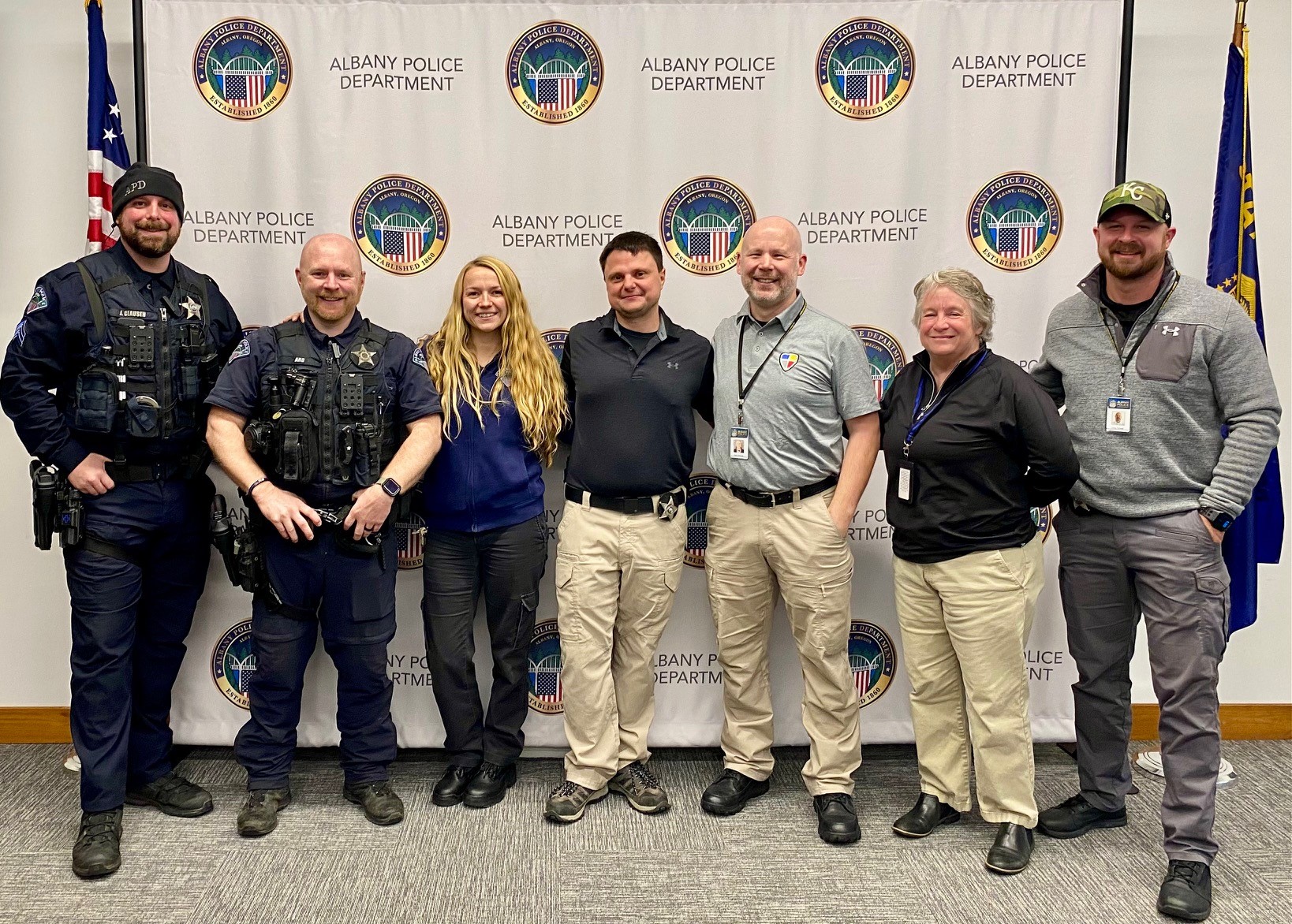
Above: The APBA donated $7,000 to the Willamette Valley First Responder Chaplains in 2024.
Donate!
Funding for the APBA is generated through APD employee contributions and private donations. Would you like to help fund our mission? We accept donations through Venmo:

Scholarships
Each year, the APBA offers two $1,000 scholarships to Greater Albany Public School District (or qualified Albany home study) graduating seniors with a GPA of 3.0 or higher. Recipients will receive a one-time award sent directly to their chosen accredited 2-year or 4-year college or university program.
Learn more and apply for this scholarship.
Sponsorships
Throughout the year, the APBA proudly sponsors several youth sports teams within the community. The APBA also participates with community-focused agencies including the Boys and Girls Club, The ABC House (Child Advocacy Center), Court Appointed Special Advocate (CASA) Program, and Oregon Special Olympics to name a few. The motto of the Albany Police Department is “Excellence Through Service”. The Albany Police Benevolent Association accentuates that philosophy with our motto, “Serving Our Community”.
Albany Safety Foundation
Albany Safety Foundation
 The Albany Safety Foundation (ASF) is a private, non-profit 501(c)3 organization. The main purpose of the foundation is to raise funds for the following Fire and Police programs in Albany.
One example of the work the foundation has done to date is training in CPR and proper heart defibrillator (AED) use to approximately 700 Greater Albany Public Schools 8th grade students each school year. Additionally, the foundation has helped equip 14 Albany Police Department patrol cars and qualifying City public places with AEDs.
You can make a donation by visiting the foundation website at
- Details
Public Records Requests
Police public records request form
For all other public records requests, click here.
APD Events & Programs
Citizens' Police Academy Application
National Night Out Event Scheduling
Patrol Observation (Ride-Along) Requests
Business
Alcohol
OLCC Local Government Recommendation
Mobile Food Units (food carts)
Selling/Soliciting
Secondhand Dealer Application (AMC 7.90)
Door-to-Door Solicitor License (AMC 5.05)
Trespass Letter of Consent
What is a Trespass Letter of Consent?
Business Trespass Letter of Consent
Personal Safety
Linn Co. Restraining Order eForms
WARNING: Your Internet activity can be tracked. It is impossible to completely clear the "footprints" showing where each site visitor has been. If the person who is harming you has access to your computer, use a trusted friend's computer or a computer at the library. If you need immediate assistance, call 911 or the National Domestic Violence Hotline at 1-800-799-7233 and TTY 1-800-787-3224.
Personal Property
Home Security System Alarm Permits
(AMC 7.74.040)
Exception for Number of Dogs
Permitted on Property (AMC 6.04.015)
An accurate list of your valuables is important when
reporting a theft or burglary to the police department.
Temporary Use of an RV as Housing
(AMC 13.36.180)
Residential Trespass Letter of Consent
Trespass Letter of Consent allows an officer to immediately act on your behalf against a person trespassing on your private property.
Streets and Parking
Central Albany Parking Area (AMC 13.21)
Towing
- Details
Talk to your kids
- Listen... Really listen to what your child tells you about friends, the neighborhood, worries, and fears. Thoughtful listening builds communication and trust, which are keys to helping your kids grow up safe.
- Talk with your kids about drugs, violence, and other problems.
- Make your family values clear, and provide a good example.
- Make sure you know your child's friends and the friends' parents.
- Check out the neighborhood with your child. Find out where he or she feels safe and unsafe. Work with neighbors to address problems such as unsafe "shortcuts," dangerous intersections, areas where shrubbery needs trimming back, lack of safe places to seek help.
- Set up clear rules for play after school, on weekends, and during "time off" in the summer or at holidays. Help your child review them regularly.
- Urge kids to play in groups, which are far less susceptible to an approach by strangers.
- Be a helping adult. Let kids know that they can tell you anything and that you will listen caringly. Mentor a child who needs adult support.
Curfew
AMC 7.44.110 Responsibility of guardian or parent.
It is unlawful for any parent, legal guardian, or any other adult having the legal care and custody of any minor person under the age of 18 years, to allow or permit any such person to go upon or be upon any street, alley, park or any public place between 10:30 p.m. on Sunday, Monday, Tuesday, Wednesday, and Thursday, and 5:30 a.m. of the following morning, and between midnight on Friday and Saturday and 5:30 a.m. of the following morning, unless accompanied by a parent or legal guardian or any other person lawfully and properly accompanying such minor person. (Ord. 3228 § 2,1965; Ord. 1555 § 2, 1943).
At what age can a child be left home alone?
Legally at 10 years of age; however, you may want to consider ORS 163.545 Child neglect in the second degree.
(1) A person having custody or control of a child under 10 years of age commits the crime of child neglect in the second degree if, with criminal negligence, the person leaves the child unattended in or at any place for such period of time as maybe likely to endanger the health or welfare of such child
(2) Child neglect in the second degree is a Class A misdemeanor.
What is the legal babysitting age?
There is no law regarding a specified babysitting age. What is being taught by the local classes offered to prospective sitters is age 11 or 12. The law that may pertain to the 12 years of age follows.
161.290 Incapacity due to immaturity.
(1) A person who is tried, as an adult in a court of criminal jurisdiction is not criminally responsible for any conduct which occurred when the person was under 12 years of age.
(2) Incapacity due to immaturity, as defined in subsection (1) of this section is a defense.
- Details
