
Water Quality Report
To our valued customers,
The City of Albany is pleased to present the 2025 Annual Water Quality Report for Albany and Millersburg.
This report provides important information about the high-quality drinking water Albany provides to homes, businesses, and industry 24 hours a day, year-round. This information is provided to you in compliance with U.S. Environmental Protection Agency requirements.
Albany regularly monitors the quality of our water to ensure we are producing and delivering excellent drinking water. In 2025, Albany met or exceeded all state and federal standards for safe drinking water. We place great importance on delivering excellent water and work hard to meet our goal of providing high-quality, dependable service to all our customers.
If you’re seeking more historic and specific data, more information can be found on the Oregon Health Authority’s website:
- Albany: https://yourwater.oregon.gov/inventory.php?pwsno=00012
- Millersburg: https://yourwater.oregon.gov/inventory.php?pwsno=01533
If you have any questions about this report or the City’s drinking water system, please reach out:
- Using the City of Albany's contact form
- In Albany, call 541-917-7600
- In Millersburg, call 458-233-6300
- Attend an Albany City Council meeting, held at least twice per month at City Hall, 333 Broadalbin Street SW. Check the Events and Public Meetings calendar for exact dates and times.
Scott LaRoque
Utility Superintendent
Public Works
City of Albany, Oregon

Information about lead
Lead can cause serious health problems, especially for pregnant women and young children. Lead in drinking water is primarily from materials and components associated with service lines and home plumbing. The City of Albany is responsible for providing high-quality drinking water and removing lead pipes, but cannot control the variety of materials used in plumbing components in your home. You share the responsibility for protecting yourself and your family from the lead in your home plumbing. You can take responsibility by identifying and removing lead materials within your home plumbing and taking steps to reduce your family's risk. Before drinking tap water, flush your pipes for several minutes by running your tap, taking a shower, doing laundry or a load of dishes. You can also use a filter certified by an American National Standards Institute accredited certifier to reduce lead in drinking water. If you are concerned about lead in your water and wish to have your water tested, contact Albany Public Works at 541-917-7600. Information on lead in drinking water, testing methods, and steps you can take to minimize exposure is available at https://www.epa.gov/safewater/lead
Related information:
What the EPA Wants You to Know about Contaminants in Source Waters
Drinking water, including bottled water, may reasonably be expected to contain at least small amounts of some contaminants. The presence of contaminants does not necessarily indicate that water poses a health risk. More information about contaminants and potential health effects can be obtained by calling the Environmental Protection Agency’s Safe Drinking Water Hotline at 800-426-4791 or at epa.gov/safewater.
The sources of drinking water (both tap water and bottled water) include rivers, lakes, streams, ponds, reservoirs, springs and wells. As water travels over the surface of the land or through the ground, it dissolves naturally-occurring minerals and, in some cases, radioactive material, and can pick up substances resulting from the presence of animals or from human activity.
Contaminants in drinking water sources may include:
- Microbial contaminants
- such as viruses and bacteria, which may come from sewage treatment plants, septic systems, agricultural livestock operations, and wildlife;
- Inorganic contaminants
- such as salts and metals, which can be naturally-occurring or result from urban stormwater runoff, industrial or domestic wastewater discharges, oil and gas production, mining, or farming;
- Pesticides and herbicides
- which may come from a variety of sources such as agriculture, urban stormwater runoff, and residential uses;
- Organic chemical contaminants
- including synthetic and volatile organic chemicals, which are byproducts of industrial processes and petroleum production, and which can also come from gas stations, urban stormwater runoff, and septic systems;
- Radioactive contaminants
- which can be naturally-occurring or be the result of oil and gas production and mining activities.
In order to ensure that tap water is safe to drink, EPA prescribes regulations that limit the amount of certain contaminants in water provided by public water systems. Food and Drug Administration regulations establish limits for contaminants in bottled water that must provide the same protection for public health.
Special Notice for Immuno-compromised Persons
Some people may be more vulnerable to contaminants in drinking water than the general population. Immuno-compromised persons such as those with cancer undergoing chemotherapy or who have undergone organ transplants, people with HIV/AIDS or other immune system disorders, some elderly, and infants can be particularly at risk from infections. These people should seek advice about drinking water from their health care providers. Guidelines from the Environmental Protection Agency and Centers for Disease Control and Prevention on appropriate means to lessen the risk of infection by cryptosporidium and other microbial contaminants are available from the Safe Drinking Water Hotline at 800-426-4791.
Where do we get our drinking water?
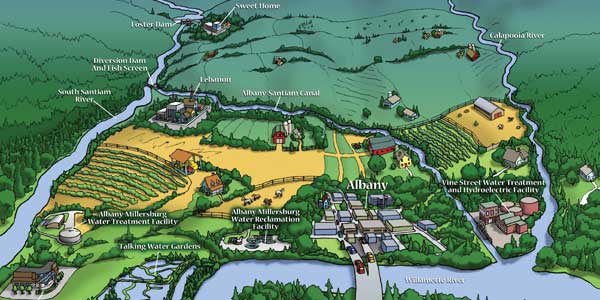
The cities of Albany and Millersburg receive their drinking water from the Santiam River system through one of two water treatment plants.

Albany-Millersburg Treatment Plant
The Albany-Millersburg treatment plant uses membrane technology to filter water from the Santiam River. Membranes are thin layers of material that separate dirt, sand, and microorganisms from water. This plant is designed to produce up to 12 million gallons of treated water per day.

Vine Street Treatment Plant
The Vine Street treatment plant uses mixed-media filter technology to treat water from the Santiam-Albany Canal supplied by the South Santiam River. Mixed-media filters are made up of different sizes of sand, anthracite coal, and garnet to attract and trap dirt, sand, and microorganisms. This plant is designed to produce up to 16 million gallons of treated water per day.
After filtration, the water is disinfected to inactivate any remaining microorganisms, the pH is adjusted to reduce corrosion of piping and plumbing components, and fluoride is added to help prevent dental cavities. The water is then ready to be distributed to our customers. The water distribution system consists of seven reservoirs, six pumping stations, and about 300 miles of pipeline that serve customers in Albany and Millersburg.
Source Waters
A Source Water Assessment Report was completed by the Oregon Department of Environmental Quality in 2002 for the Santiam-Albany Canal serving the Vine Street water treatment plant. The report was updated in January 2019 and now includes the Santiam River, which serves the Albany-Millersburg water treatment plant. The report concluded that the source water may be susceptible to contamination from sediments (turbidity), microbiological sources, and nutrients. One group of contaminants that is sometimes found in surface water is pesticides or herbicides. These chemicals often run off from agricultural or residential properties and into the water. Albany has occasionally found very low levels of common pesticides in our raw water sampling, far below any levels that would impact human health. While the concentrations of these chemicals are very low, we would prefer not to find them at all and encourage anyone using pesticides or herbicides to follow label directions, avoid spraying along the banks of the canal or other waterways, and store chemicals away from surface water. Because Albany’s water is highly treated, drinking water quality impacts are not likely to occur from any of these potential contaminants.
The source water assessment documents are available upon request by calling 541-917-7600.

Regulated Contaminants
The City of Albany sampled for 90 regulated contaminants on a continuous, daily, monthly, quarterly, annual, or reduced monitoring program in 2025. The federal Environmental Protection Agency requires disclosure of any regulated contaminants that were detected in the Albany-Millersburg public water system. Where allowed to monitor less often than once a year, the City of Albany is required to report contaminants detected within the last five years.
The following tables show the regulated contaminants detected in 2025. At no time were any of the detected contaminants found to be above the maximum level allowed in drinking water (MCL).
Treatment Plants
Vine Street and Albany-Millersburg Joint Water Treatment Plants (PWS #4100012)
Microbial
| Contaminant | Maximum Level Reported | Range of Detections | MCL | Unit of Measurement | Recommended Health Goal (MCLG) | Major Sources | Does our water meet the standard? |
|---|---|---|---|---|---|---|---|
| Turbidity Vine Street WTP1 |
0.14 | 0.04 - 0.13 | 0.15 | NTU (TT) |
N/A | Soil runoff | Yes |
| Turbidity AM Joint WTP1 |
0.04 | 0.01 - 0.04 | 1 | NTU (TT) |
N/A | Soil runoff | Yes |
| Cryptosporidium Vine Street WTP2 |
0.016 | ND - 0.01 | N/A | Oocyst/L | N/A | Human and animal waste | Yes |
Chemicals
| Contaminant | Maximum Level Reported | Range of Detections | MCL | Unit of Measurement | Recommended Health Goal (MCLG) | Major Sources | Does our water meet the standard? |
|---|---|---|---|---|---|---|---|
| Fluoride3 | 0.71 | 0.1-0.96 | 4 | PPM | 4 | Additive which promotes strong teeth | Yes |
| Total Organic Carbon (TOC)3 | 1.33 | 0.60-2.70 | N/A | PPM (TT) |
N/A | Naturally present in the environment | Yes |
| Combined Radium 226/228 | ND | ND | 5 | pCi/L | 0 | Erosion of natural deposits | Yes |
Albany Distribution
Albany Water Distribution System (PWS #4100012)
Chemicals
| Contaminant | Maximum Level Reported | Range of Detections | MCL | Unit of Measurement | Recommended Health Goal (MCLG) | Major Sources | Does our water meet the standard? |
|---|---|---|---|---|---|---|---|
| Chlorine (Free Cl2 Residual)3 |
1.17 | 0.1-1.17 | 4 (MRDL) | PPM | 4 (MRDLG) |
Water additive used to control microbes | Yes |
| Total Trihalomethanes (TTHM)4 | 59 | 17.8-71.9 | 80 | PPB | N/A | Byproduct of drinking water disinfection | Yes |
| Haloacetic Acids (HAA5)4 | 33 | 10.8-48.1 | 60 | PPB | N/A | Byproduct of drinking water disinfection | Yes |
| Lead5 | 2.6 | 0-2.6 | 15 (AL) |
PPB | 0 | Corrosion of household plumbing | Yes |
| Copper5 | 0 | 0-0.00 | 1.3 (AL) |
PPM | 1.3 | Corrosion of household plumbing | Yes |
Millersburg Distribution
Millersburg Water Distribution System (PWS #4101533)
Chemicals
| Contaminant | Maximum Level Reported | Range of Detections | MCL | Unit of Measurement | Recommended Health Goal (MCLG) | Major Sources | Does our water meet the standard? |
|---|---|---|---|---|---|---|---|
| Chlorine (Free Cl2 Residual)3 |
1.38 | 0.38-1.38 | 4 (MRDL) | PPM | 4 (MRDLG) |
Water additive used to control microbes | Yes |
| Total Trihalomethanes (TTHM)4 | 43 | 17.2-64.7 | 80 | PPB | N/A | Byproduct of drinking water disinfection | Yes |
| Haloacetic Acids (HAA5)4 | 24 | 10.7-35.5 | 60 | PPB | N/A | Byproduct of drinking water disinfection | Yes |
| Lead6 | 0 | 0-0.00 | 15 (AL) |
PPB | 0 | Corrosion of household plumbing | Yes |
| Copper6 | 0 | 0-0.00 | 1.3 (AL) | PPM | 1.3 | Corrosion of household plumbing | Yes |
Definitions and Notes
Definitions
Action Level (AL): The concentration of a contaminant which, if exceeded, triggers treatment or other requirements that a water system must follow.
Maximum Contaminant Level (MCL): The highest level of a contaminant that is allowed in drinking water. MCLs are set as close to the MCLGs as feasible using the best available treatment technology.
Maximum Contaminant Level Goal (MCLG): The level of a contaminant in drinking water below which there is no known or expected risk to health. MCLGs allow for a margin of safety.
Maximum Residual Disinfectant Level (MRDL): The highest level of a disinfectant allowed in drinking water. There is convincing evidence that addition of a disinfectant is necessary for control of microbial contaminants.
Maximum Residual Disinfectant Level Goal (MRDLG): The level of a drinking water disinfectant below which there is no known or expected risk to health. MRDLGs do not reflect the benefits of the use of disinfectants to control microbial contamination.
Nephelometric Turbidity Units (NTU): The units of turbidity from an instrument that measures the propensity of particles to scatter a light beam focused on them.
Parts Per Million (ppm): One part per million corresponds to one penny in $10,000 or approximately one minute in two years. One part per million is equal to 1,000 parts per billion or one milligram/liter (mg/L).
Part Per Billion (ppb): One part per billion corresponds to one penny in $10,000,000 or approximately one minute in 2,000 years. One part per billion is equal to one microgram/liter (ug/L).
Picocuries per liter (pCi/l): A measure of radioactivity.
Treatment Technique (TT): A required process intended to reduce the level of a contaminant in drinking water.
Notes
N/A = Not Applicable
1 Turbidity is a measure of the cloudiness of the water. Turbidity is monitored because it is a good indicator of the effectiveness of Albany's filtration system at removing contamination. Albany monitors turbidity at each filter on a continuous basis and records the value every 15 minutes. The highest single measurement detected is reported. For compliance, 95% of monthly samples must be below the MCL. If the Maximum Level Reported for turbidity exceeds the MCL, the percent of monthly samples that met the turbidity limits for our filtration technology is also reported.
2 Cryptosporidium is a protozoan that can be found in surface water sources, generally from human or animal waste contamination. The City completed the second round of cryptosporidium sampling between October 2015 and September 2017, as required by the Long-Term 2 Enhanced Surface Water Treatment Rule, to determine the level of cryptosporidium in the raw water (before treatment) at both the Vine Street Water Treatment Plant and the Albany-Millersburg Joint Water Treatment Plant. The samples were analyzed for the number of oocysts, which is the form the organism takes when in the environment, per liter of water. The highest arithmetic average of all sample concentrations in any 12 consecutive-month period is calculated for each WTP. That number is used to determine if additional treatment is necessary to reduce the risk of cryptosporidium contamination in our drinking water. Cryptosporidium was not detected in any samples at the AM Joint WTP making the arithmetic average also non-detect. The highest arithmetic average for the Vine Street WTP was 0.016 oocysts/L, which is below the 0.075 oocysts/L threshold. Therefore, no additional treatment is required for either the AM Joint WTP or the Vine Street WTP.
3 Compliance levels reported for fluoride and total organic carbon (TOC) are calculated by averaging the sample results at each plant over a running 12-month period. The compliance level reported for free chlorine is calculated by averaging the sample results from all sampling sites over a running 12-month period. The range is determined by individual tests at single sites.
4 The detected level of TTHMs and HAA5s is the highest running annual average at any of the individual monitoring locations and the range of all monitoring locations.
5 A total of thirty homes in the Albany distribution system were tested for lead and copper at the customer’s tap in August 2023. None of the homes exceeded the action level for lead or copper. All home owners were notified of their test results. Lead and copper standards are met if at least 90 percent of the samples have lead levels less than or equal to 15 ppb and copper levels less than or equal to 1.3 ppm. The 90th percentile was non-detect for lead and non-detect for copper in the Albany distribution system. The 90th percentile is reported to the Oregon Health Authority. The next sample set will be collected in summer 2026.
6 Ten homes in the Millersburg distribution system were tested for lead and copper at the customer’s tap in August 2023. None of the homes exceeded the action level for lead or copper. All home owners were notified of their test results. Lead and copper standards are met if at least 90 percent of the samples have lead levels less than or equal to 15 ppb and copper levels less than or equal to 1.3 ppm. The 90th percentile was non-detect for lead and non-detect for copper in the Millersburg distribution system. The 90th percentile is reported to the Oregon Health Authority. The next sample set will be collected in summer 2026.
